Tristero stamps
The Crying of Lot 49Tristero stamps are the novel’s most tangible evidence of a clandestine postal system: artifacts that appear on official-looking postage, in a stamp catalogue, and among Pierce Inverarity’s estate assets. Their altered designs invite Oedipa Maas to read a hidden history of resistance into American postal imagery, but their uncertain authenticity and their connections to Inverarity leave the mystery unresolved. The stamps function both as possible instruments of communication and as signs whose meaning may be genuine, fabricated, or deliberately planted.
Appearance and Recognition
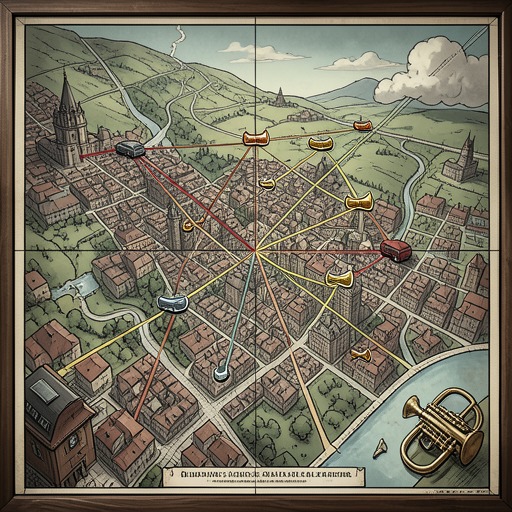
The stamps are identified by a recurring muted post horn watermark, which Oedipa first recognizes on a 1940 Pony Express commemorative stamp. At a meeting with Genghis Cohen, he treats the stamp with benzine and examines it under a strong lamp; the horn-shaped mark appears in the watermark, slightly right of center. The familiar sign therefore turns up not as an obvious printed emblem but as a feature revealed by close inspection of the stamp itself.
The stamp’s connection to the mystery reaches beyond Cohen’s collection. At The Scope, Oedipa remembers a message on a latrine wall advertising contact through WASTE, accompanied by a faint symbol of a loop, triangle, and trapezoid. When she later sees Stanley Koteks drawing the sign, she invokes the name Kirby from the notice to test his response. The repeated symbol links a public invitation, a mark on a stamp, and a possible network, although these encounters do not by themselves establish who made the marks or what organization they represent.
Altered Postal Images
Oedipa comes to recognize a series of stamps whose official subjects have been subtly changed. On the 15-cent dark-green stamp from the 1893 Columbian Exposition issue, three courtiers receiving news appear to show uncontrollable fright. The 3-cent Mothers of America issue of 1934 replaces flowers beside Whistler’s Mother with poisonous plants. On the 1947 Postage Stamp Centenary issue, a Pony Express rider’s head is set at an unsettling angle; the 1954 deep-violet 3-cent regular issue gives the Statue of Liberty a faintly menacing smile.
The alterations also extend to later and less respectable-looking examples. An aerial view on the 1958 Brussels Exhibition issue includes a horse and rider set apart from the other fairgoers. Other suspected examples include Cohen’s Pony Express stamp, a Lincoln 4-cent stamp marked “U. S. Potsage,” and an 8-cent airmail stamp on a tattooed sailor’s letter in San Francisco. These variations make the stamps appear to speak through discrepancies within official imagery: the surface remains recognizable, while small disturbances suggest another presence beneath it.
Postal History and the Underground Network
The stamps acquire political significance through accounts of private mail delivery and federal postal power. Mike Fallopian is researching the history of private delivery in the United States, linking the Civil War to postal reform beginning around 1845. His account emphasizes measures intended to drive independent routes into financial ruin and the government’s suppression of surviving competitors in 1861. In this history, the stamps’ unofficial or disguised marks point toward a conflict over who may carry messages, not merely toward an eccentric collecting puzzle.
Emory Bortz supplies a further account of Tristero’s supposed adaptation to that pressure. He says that Tristero refugees who came to America after the 1849 reaction found independent carriers being displaced by postal reform and later suppressed when they tried to compete. Rather than openly restoring their European enterprise, they allegedly continued in conspiracy, changing their opposition into concealment: during the Civil War, their messengers supposedly traveled west disguised as Indigenous people and learned Siouan and Athapascan dialects. Bortz characterizes this method as silence and impersonation, with opposition concealed beneath apparent allegiance. The stamps fit that account because some are openly marked while later ones are described as nearly legitimate in appearance.
Catalogue, Estate, and Uncertain Proof
A particularly explicit example comes to Cohen through a friend in San Francisco: an old American stamp bearing the muted post horn, a belly-up badger, and the motto “WE AWAIT SILENT TRISTERO’S EMPIRE.” Cohen finds the stamp represented in a pasted-in addendum to a Scott catalogue as item 163L1, titled “Tristero Rapid Post, San Francisco, California.” Its assigned place between two New York local-post listings gives the alleged local service a bibliographic trace, but Oedipa immediately recognizes that an addendum could have been pasted into the book. The catalogue entry is evidence to investigate, not independent proof of the stamp’s history.
The provenance problem intensifies when Oedipa traces the relevant properties back to Inverarity. The shopping center containing Zapf’s Used Books and a surplus store is part of his estate, as is the Tank Theatre; Bortz teaches at San Narciso College, which Inverarity heavily endowed. Oedipa consequently wonders whether the people and places that have directed her toward Tristero are connected to Inverarity, possibly as participants in a practical joke. The stamps might document a genuine hidden network, but their circulation through locations and collections linked to the dead man also makes fabrication or orchestration seem possible.
Lot 49 and the Unresolved Claim
The final arrangements for the auction of Inverarity’s stamp collection place the suspected Tristero forgeries together as lot 49. Cohen reports that an unknown book bidder, acting through the reputable agent C. Morris Schrift, has asked to inspect the lot in advance without disclosing a name. The auction firm refuses because the client’s identity is unknown, despite the normal possibility of advance examination when the bidder is identified and covers postage and insurance.
Cohen speculates that the bidder may be connected to Tristero and may want to keep evidence of the organization out of unauthorized hands. That explanation gives the stamps a new possible consequence: their sale could expose or remove evidence of the network. Yet the bidder’s identity and purpose remain unverified, just as the stamps’ authenticity remains unsettled. By ending with the collection’s sale and an undisclosed prospective buyer, the novel turns the stamps into both objects of proof and objects whose ownership, interpretation, and very evidentiary value remain in doubt.